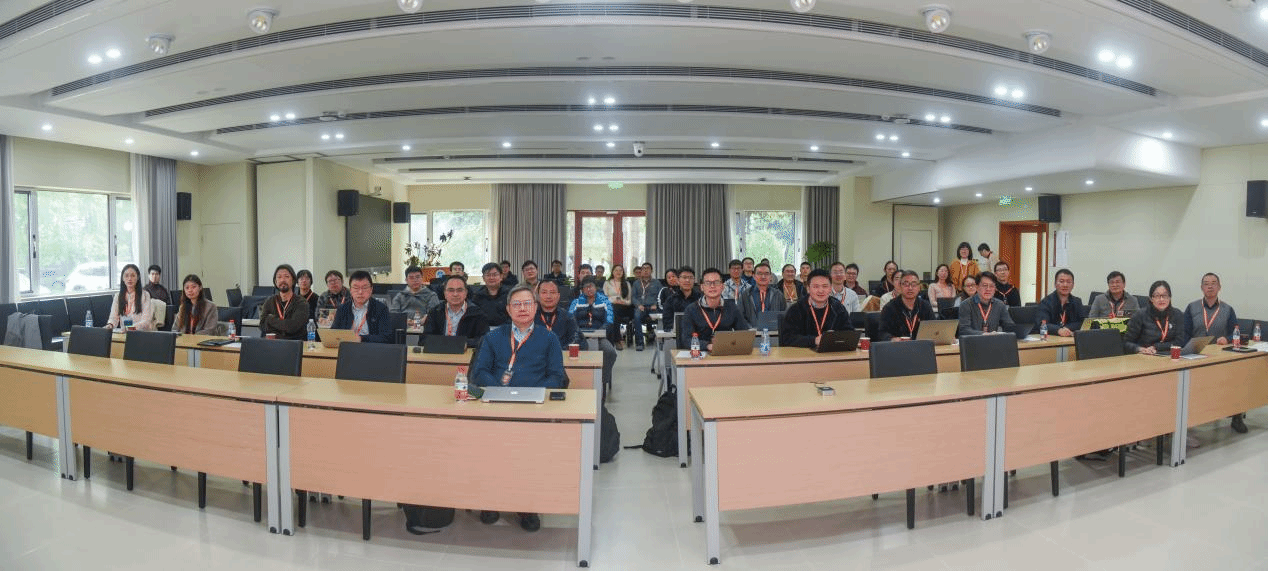
Figure: Symposium Group Photo
The Kavli Institute for Astronomy and Astrophysics (KIAA) at Peking University hosted the CSST Early Science Symposium on Galaxies and Active Galactic Nuclei (AGN) on Oct. 25-26, 2025. The Chinese Space Station Telescope (CSST) is a 2-meter telescope with a wide wavelength coverage from the near ultraviolet to the near infrared, a major Chinese initiative to be launched soon. With its wide field of view and versatile suite of instruments, CSST is designed to enable a broad range of scientific investigations.Much of the science will be designed and pursued at the CSST PKU Science Center.
KIAA organized this symposium to facilitate the integration and refinement of proposals for early science programs to be carried out during the telescope’s initial operational phase.The event brought together more than 60 experts from the domestic astronomy communityto discuss the key scientific goals in the field of galaxies and AGN thatcan beachievedwithin the first 2 years after the launch of CSST.
One of the most important projects for CSST is the main galaxy survey, whichwill obtainhigh quality multi-band images covering more than 17,500 degree of the sky in 2 years.The symposiumclarifiedscientific target fields and research directions for the maingalaxysurvey, establishedworking groupsfor each scientific topic,promotedcollaboration to implement research tasks among members, and emphasizedcross-disciplinary cooperation with Galactic and cosmology fields to facilitate early scientific outputs from CSST. Key discussion topicsincluded CSSTdeepfields andultra-deepfields, nearbygalaxyclusters, nearbygalaxies, galaxyclusters withstronggravitationallensing,and prioritycoverageareas for CSSTmaingalaxy survey. Thesediscussions helped to organize collaborations to focus on urgent tasks, including the scientific targets for early CSST science.
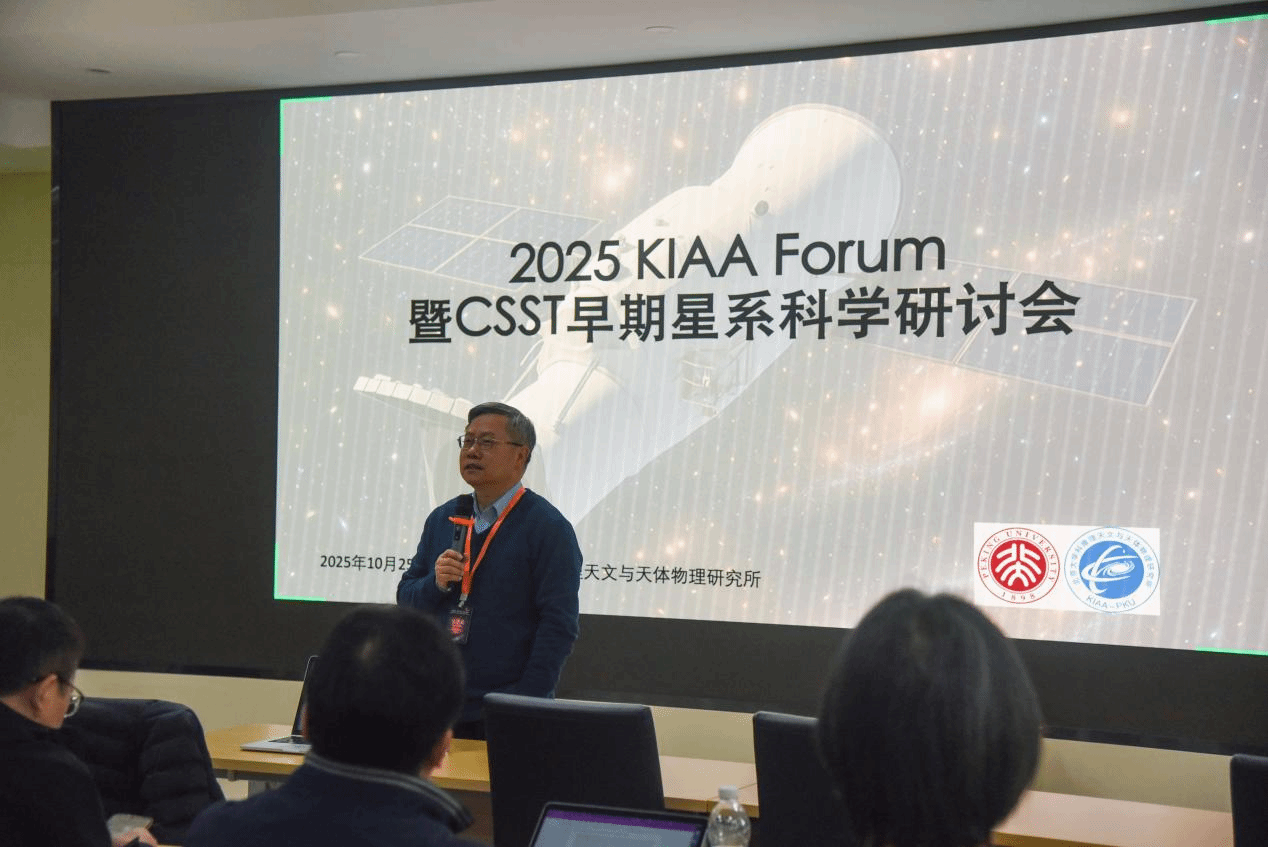
Opening address by Professor Xuebing Wu of KIAA
Duiring the symposium,leadersof early science projects,including Prof.Linhua Jiangof PKU,Profs.Xu KongandChengze Liuof USTC,andProf.Lei Haoof SHAO,delivered comprehensive presentations on various research proposals.Prof.Chao Liuof NAOC, the deputy director of the CSST Science Working Joint Center,describedthe operationsof CSST.Each presentationwas followed by discussionsoftarget field selection,observation time allocation, feasibility assessments, and strategies for collaborating on the science results.

From left to right (top row): Linhua Jiang, Xu Kong; (bottom row): Chengze Liu, Lei Hao

Symposium participants engaged in dynamic discussions and productive exchanges of perspectives.
The symposiumfostereddiscussions andreachedconsensus across many research areas. Participants agreed to merge and refine a number of proposed programs to better align with the CSST early science plan, ensuring efficient use of the telescope’s capabilities. The meeting also demonstrated the community’s strong commitment and coordinated efforts in preparing for the launch of CSST,the most important Chinese astronomical facility to be commissioned in the coming years.
The symposium was organized with the help from SOC members, including Jinyi Shangguan, Yingjie Peng, Jing Wang, Hu Zhan, Xu Kong, Zhenya Zheng, Zhaoyu Li and LOC members, including Linhua Jiang, Min Sun, Fangzhou Ren.
